What Makes a Window Energy Efficient on the North Shore?
-
Published:10/23/2026
-
ByShaunak Ahuja
Two different standards apply to a replacement window in Cook and Lake County, and they don’t require the same thing. The Illinois energy code caps U-factor at 0.28. ENERGY STAR certification in this climate zone asks for 0.22 or lower. A window can satisfy the first and still miss the second.
That gap explains why two quotes can both use the word efficient and mean different things. This guide explains what the numbers on the label mean, which features affect them, and how to compare them with your quote. For the service side, including what we install and where we work, see our North Shore window replacement page.
How Windows Lose and Gain Heat
A window transfers heat in four ways, and each efficiency feature is designed to slow one of them.
- Conduction is heat traveling through solid material, through the glass and through the frame and sash.
- Convection happens inside the sealed cavity between panes, where gas circulates and transfers heat from the warm pane to the cold one.
- Radiation is infrared energy passing through the glass, which is how heat leaves a room on a January night and how solar heat enters a south-facing window in August.
- Air leakage is unconditioned air moving through the assembly or around its perimeter.
Air leakage belongs in its own category. It’s the one mechanism governed more by the installation than by the product.
The NFRC Label: Five Numbers That Matter
The National Fenestration Rating Council rates windows based on whole-product performance, including the frame, and the EPA uses those certified ratings to evaluate windows for ENERGY STAR. That makes the label the one place where a number from one brand means the same thing as a number from another.
Ranges above are as published by NFRC in its consumer guide to window ratings.
Three of the five appear on every certified label: U-factor, SHGC, and visible transmittance. Air leakage and condensation resistance are optional, so a label without them is not defective. Those two have to be requested from the manufacturer instead.
U-factor is not R-value. R-value measures how well insulation resists heat flow, so the higher the R-value, the better. U-factor measures the rate of heat transfer, so lower is better. Walls and attics are rated by R-value, while U-factor rates windows.
What U-Factor and SHGC Do North Shore Windows Need?
Cook and Lake County sit in IECC Climate Zone 5A, which places them in the ENERGY STAR Northern zone.
The code minimum. The Illinois Energy Conservation Code adopted the 2024 IECC, as amended, effective for permit applications on or after November 30, 2025. For Climate Zone 5, the 2024 edition sets the maximum residential window U-factor at 0.28, tightened from 0.30 in the 2021 edition, a change documented in the Department of Energy's analysis of that edition. An older 0.30 figure still circulating in window guidance is that previous code ceiling, not a current target.
Illinois sets this as both a minimum and a maximum standard for residential buildings, so most local governments cannot require anything different. A municipality that has adopted the Illinois Stretch Energy Code is one of the narrow exceptions and can be stricter, so it is worth asking your village or city what applies.
The certification target. ENERGY STAR Version 7.0, in effect since October 23, 2023, certifies Northern-zone windows at a U-factor of 0.22 or lower with an SHGC of 0.17 or higher, plus air leakage at or below 0.3.
The SHGC requirement runs in an unexpected direction. It’s a floor, not a ceiling. In a heating-dominated climate, solar heat arriving through a window in winter is useful, so the Northern criteria set a minimum rather than a maximum. That’s the opposite of what a buyer in Phoenix should want.
Version 7.0 also allows equivalent-energy alternatives in the Northern zone, where a slightly higher U-factor qualifies when SHGC rises to compensate. A label reading 0.25 and 0.40 can meet the standard through this route, so a U-factor above 0.22 doesn’t automatically mean a window fails certification.
Glass and Glazing: Where Most of the Performance Lives
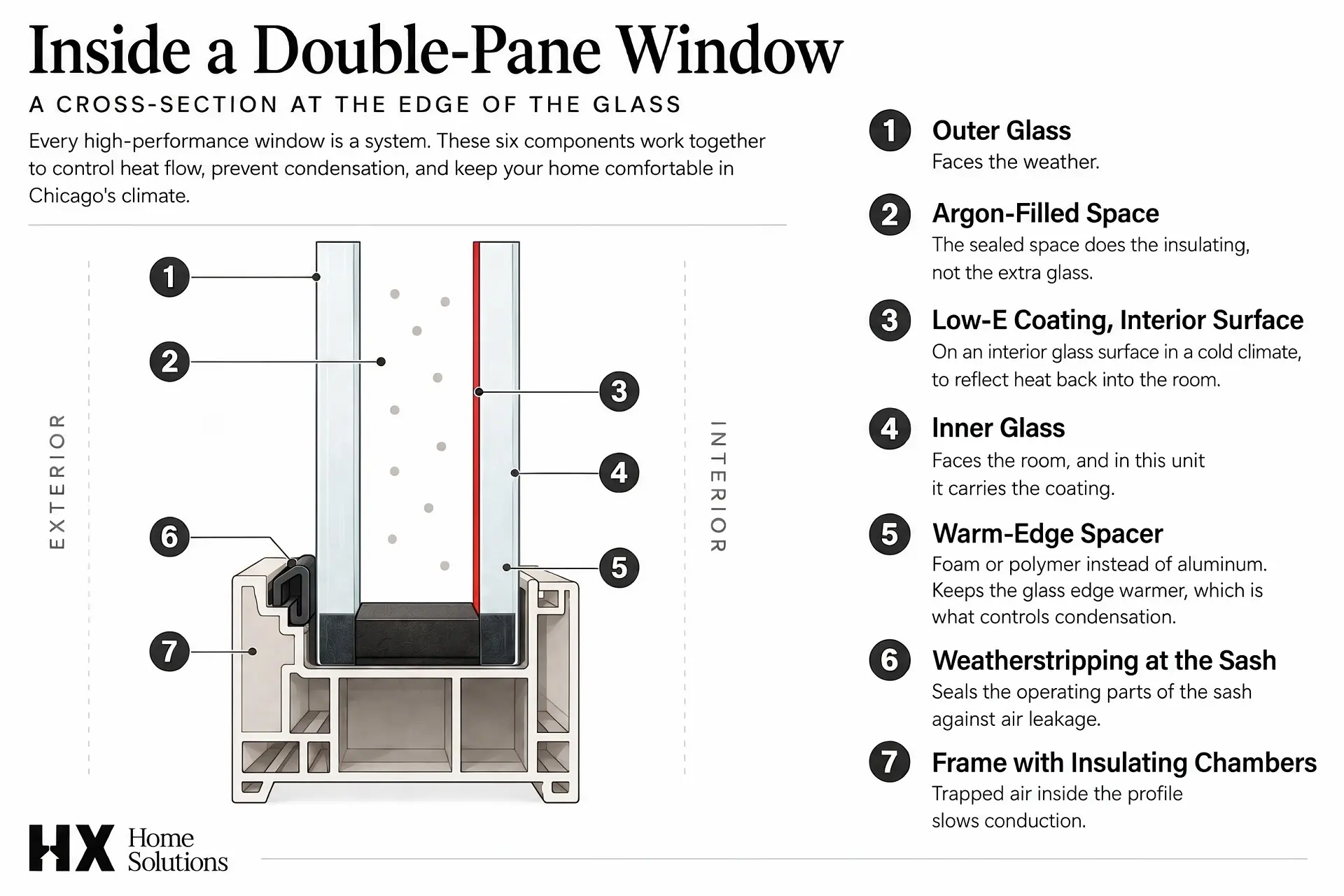
The insulated glass unit accounts for the largest share of a window's thermal performance. Several features inside it get discussed separately but work as one system.
Panes and the cavity. A second pane creates a sealed space, and that space does the insulating work rather than the extra glass itself.
Low-emissivity coatings. A Low-E coating is a microscopically thin metallic layer that reflects infrared energy while allowing visible light to pass through. Where that coating is placed matters just as much as the coating itself. In a heating-dominated climate, the coating goes on an interior glass surface to reflect heat into the room; in a cooling-dominated climate, it faces the exterior to reflect solar heat away.
Coatings also differ by purpose. High-solar-gain formulations preserve winter solar heat, while spectrally selective low-solar-gain coatings block more of it. For this region, a coating tuned toward heat retention with meaningful solar gain suits both the climate and the Northern-zone SHGC floor.
Gas fills. Argon and krypton block more heat transfer than air because they are denser. Krypton delivers greater efficiency gains at a higher cost, which is why argon is more common and why some manufacturers offer a blend of the two.
Some gas escapes over time, and that is normal. Per NFRC, citing NREL data, an efficient window loses roughly 0.5% of its gas fill per year, so after 20 years, it would still retain about 90% of its original fill. The gases are non-toxic, clear, and odorless, which makes a leak an efficiency question rather than a safety one.
Spacers. The spacer holds the panes apart at the perimeter. Older aluminum spacers conduct heat well, creating a cold band at the edge of the glass. Warm-edge spacers made of foam or polymer reduce that edge-of-glass heat flow and raise the interior glass temperature where condensation is most likely to form.
Is Triple-Pane Worth It Here?
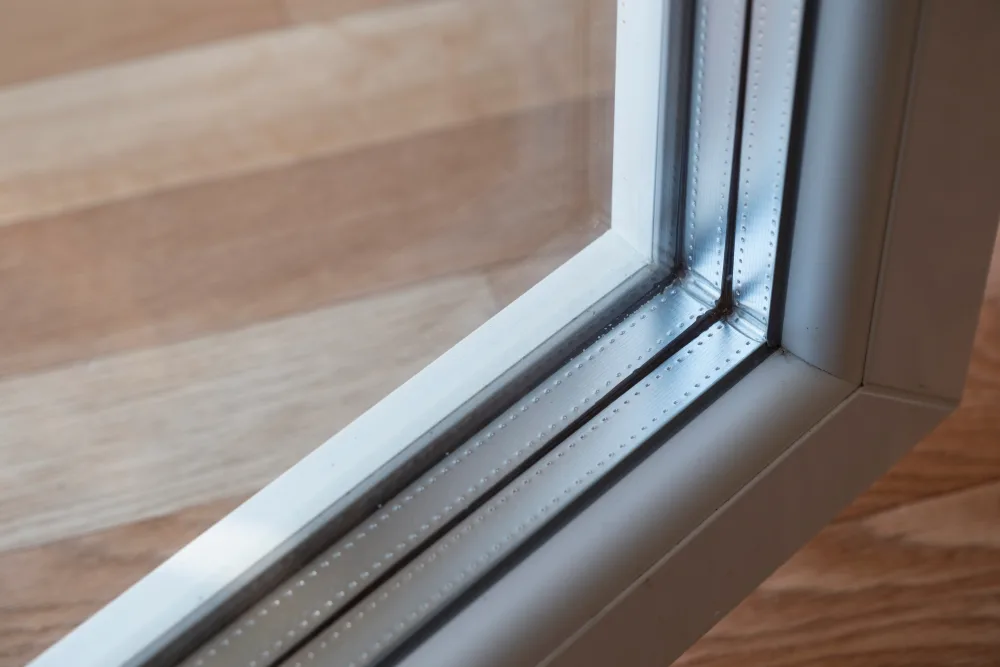
Triple-pane glass performs measurably better, and the research behind that claim is federal rather than promotional. DOE-sponsored field studies by Pacific Northwest National Laboratory and Lawrence Berkeley National Laboratory found triple-pane windows can improve a home's window energy performance by about 40%, while also improving interior comfort and blocking more exterior noise.
The historical objections were cost, width, and weight. Builders typically work with standard frame dimensions, while conventional triple-pane units are thicker and heavier. Thin triples address this with an ultra-thin, non-structural middle pane that raises insulating power while staying narrow enough to fit conventional double-pane frames, including as a replacement in an existing frame.
Triple-pane is still more expensive than double-pane, and the right choice depends on the house, window sizes, and budget. What the federal research doesn’t support is treating it as an unnecessary upgrade in a Zone 5A climate.
Which Frame Material Is Most Energy Efficient?
Frame material affects conduction through the frame and how the assembly handles expansion and contraction across a full year of Illinois weather. Department of Energy guidance doesn’t name a single material as best, and neither will we.
- Vinyl. Resists moisture, needs no painting, uses internal chambers to trap insulating air.
- Wood. Insulates well, requires maintenance on exposed exterior surfaces.
- Clad-wood. Wood interior with a low-maintenance exterior skin.
- Composite. Blends materials to balance stability against thermal performance.
- Aluminum. Conducts heat rapidly and needs an engineered thermal break to compete thermally.
- Fiberglass. Also available in the market, with expansion behavior close to that of glass.
What matters is the material's conductivity, whether the frame is chambered or foam-filled, whether a metal frame has a thermal break, and how it moves with temperature. For a fuller side-by-side, see our comparison of vinyl, wood, and fiberglass frames.
Why Installation Decides Whether Any of It Matters
Department of Energy guidance makes the point simply: even highly efficient windows can leave a house feeling drafty when they’re poorly installed. Ratings describe how a window performs in a laboratory, but performance in a wall depends on what happens around the perimeter.
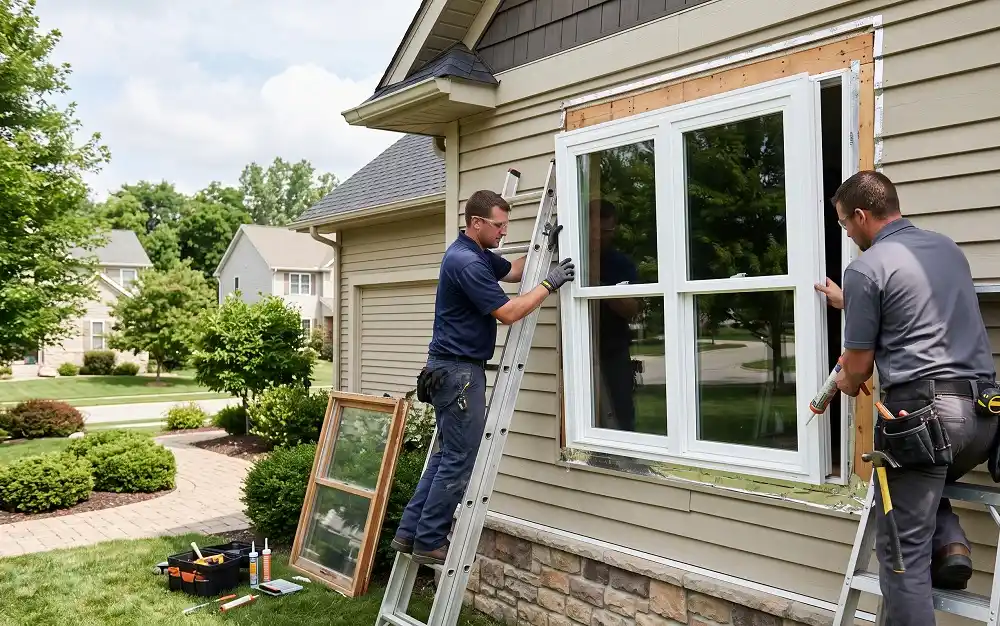
Correct installation seals the rough opening gap, generally a quarter inch to a half inch, with non-expanding foam. Expanding foam can exert enough pressure to bow a frame and interfere with operation.
Flashing directs water away from the assembly; the shim space gets insulated rather than left hollow, and weatherstripping handles air leakage through the operating parts of the sash. If drafts are the reason a replacement is on the table, our guide to diagnosing drafty windows covers identifying the source first.
#cta_start
Window Installation Built for North Shore Winters
A certified rating describes how a unit performs in a laboratory, but it will perform as expected in a wall only when the opening is properly sealed. Our factory-trained, licensed, and insured installers handle flashing, shim-space insulation, and air sealing on Pella and ProVia window replacements across the North Shore, Cook County, and Lake County. Get in touch to work with us!
#cta_end
How Much Do Energy-Efficient Windows Actually Save?
ENERGY STAR reports that replacing single-pane windows with certified windows lowers household energy bills by an average of up to 13% nationally. The Department of Energy's own windows fact sheet gives a range of 7–15% or more, depending on location and on what is being replaced. Both figures use single-pane windows as the baseline, so replacing functional double-pane windows produces a smaller change.
The result on a specific house depends on the condition of the existing windows, total window area and orientation, insulation and air sealing elsewhere in the envelope, the heating and cooling equipment, and how the house is used.
One figure is worth stating precisely because a distorted version often appears in sales materials. Per the Department of Energy, heat gain and loss through windows account for 25–30% of residential heating and cooling energy use.
That is a share of the heating and cooling load. It doesn’t mean that 30% of a home's total energy escapes through the glass, nor is it a projection of potential savings.
How to Read the Label on a Quote You Already Have
All of this becomes practical where two quotes sit side by side. The certified label uses a fixed layout, so the numbers are always in the same place.
- U-factor is the top-left number. Check it against 0.28 for code and 0.22 for ENERGY STAR certification in this zone.
- SHGC is the top-right number. In the Northern zone, it should be 0.17 or higher. A low figure suited to a hot climate suggests the product was specified for the wrong region.
- Visible transmittance sits at the left of the middle or bottom row.
- Air leakage, when shown, sits at the right of the middle or bottom row. Anything above 0.3 cannot be ENERGY STAR certified.
- Condensation resistance, when shown, sits at the bottom left. Higher is better, and it matters more here than in most of the country.
Two things are worth confirming beyond the label. Ask whether a U-factor represents the whole window or just the center of the glass, since center-of-glass figures can look better but aren’t directly comparable. And ask whether the rating applies to the size and configuration actually being quoted, since ratings are certified per product.
The Whole Window, Not One Feature
No single feature makes a window energy efficient. The glass, the coatings, the gas fill, the spacer, the frame, and the rough-opening seal all work together, and the certified label shows how that complete assembly performs in numbers so you can actually compare.
We install Pella and ProVia windows, and both publish glass packages made for northern climates. Pella's InsulShield collection includes AdvancedComfort Low-E with argon, which Pella designates for northern United States climates. ProVia's ComforTech glazing system uses argon in double-glazed configurations and krypton in triple-glazed ones, with an Energy Advantage hardcoat Low-E option that adds ultraviolet protection while retaining solar heat you’ve gained.
If you want a second read on the numbers in front of you, HX Home Solutions will go through the certified ratings line by line, including which ones matter in Zone 5A and which do not affect a home here. Schedule a consultation to get started.